

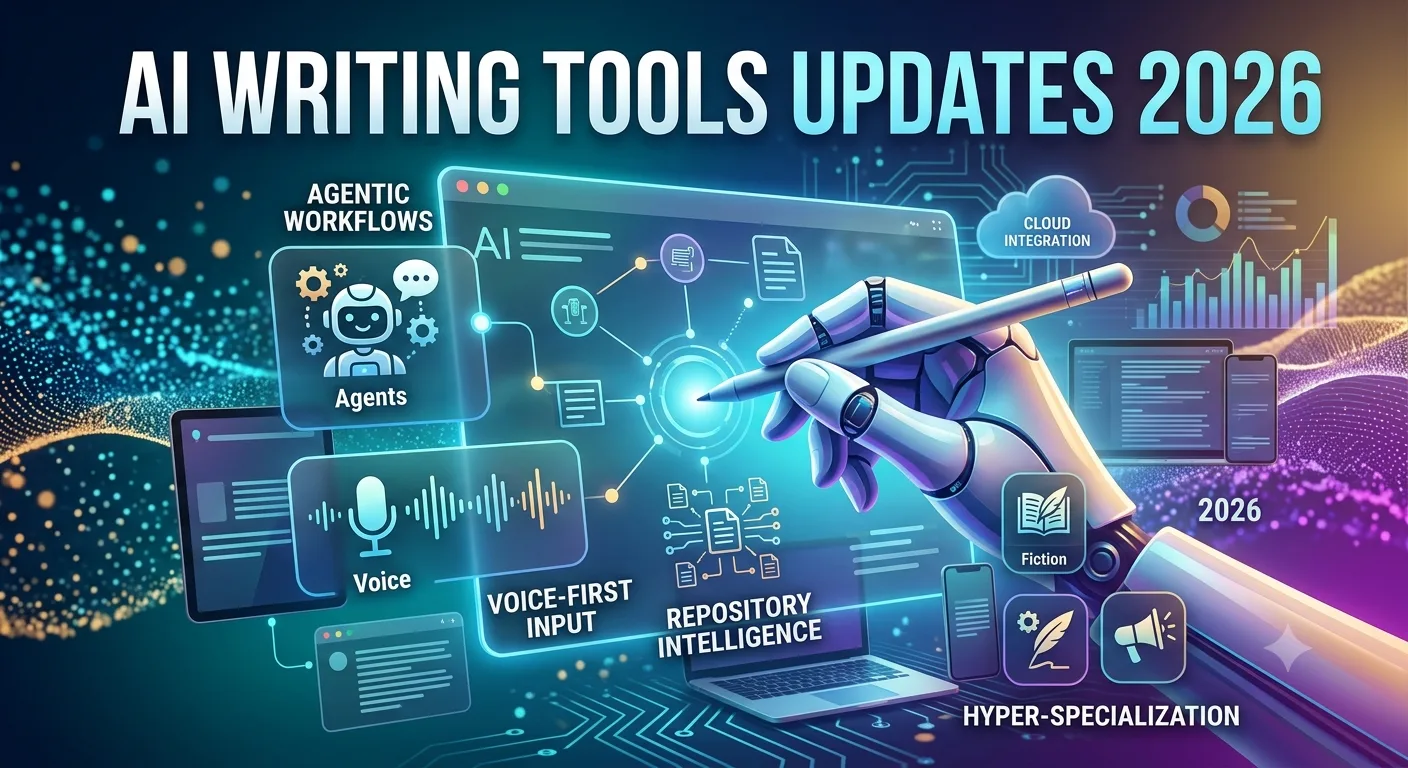
AI writing tools have changed dramatically over the last few years. In 2026, they are no longer just content generators. They are research assistants, SEO advisors, brand voice trainers, multilingual editors, and workflow automation partners.
For Indian users—bloggers, startups, agencies, students, and enterprises—this shift is significant. Costs are evolving. Features are expanding. Regulations around AI-generated content are becoming stricter. And the gap between basic tools and advanced platforms is wider than ever.
This guide covers what’s new in AI Writing Tools in 2026, how updates impact you, what to look for before choosing a tool, and where the industry is heading next.
Major Updates in AI Writing Tools (2026)
1. Smarter Context Memory
Earlier tools forgot context after a few paragraphs. In 2026:
- Long-form memory has improved
- Tools understand brand guidelines
- They maintain consistent tone across 2,000+ words
- Some integrate directly with company knowledge bases
Why it matters:
Indian businesses scaling content marketing need consistent voice across blogs, ads, and emails. Context-aware AI reduces editing time significantly.
2. Built-in SEO Intelligence
Modern AI Writing Tools now include:
- Real-time keyword optimization
- Search intent analysis
- Content gap suggestions
- Internal linking ideas
- Featured snippet formatting
Instead of writing first and optimizing later, AI now supports SEO while drafting.
However, tools still require human judgment. AI can suggest keywords, but only you can align them with brand strategy and actual search intent.
3. Multilingual & Indian Language Support
One of the biggest updates in 2026 is improved regional language capability.
Top tools now support:
- Hindi
- Tamil
- Telugu
- Bengali
- Marathi
- Gujarati
- Hinglish tone adaptation
For Indian creators, this opens massive opportunities in regional SEO and local marketing.
Practical use case:
An edtech startup can generate course landing pages in English and adapt them into Hindi and Tamil while maintaining message consistency.
4. Fact-Checking & Citation Features
Earlier AI models often produced “hallucinated” information. Newer updates include:
- Web-connected research modes
- Source referencing
- Inline citation support
- Confidence scoring for claims
That said, no AI tool is perfect. You should still verify sensitive data, especially in finance, health, or legal content.
5. AI + Workflow Automation
AI writing tools now connect with:
- Google Docs
- Notion
- WordPress
- Webflow
- CRM systems
- Email marketing platforms
This reduces copy-paste work. Content can move from draft to publish with minimal friction.
For agencies in India managing multiple clients, this saves hours each week.
Comparison: Basic vs Advanced AI Writing Tools (2026)
| Feature | Basic Tools | Advanced Tools |
|---|---|---|
| Context Memory | Limited | Long-form contextual |
| SEO Suggestions | Minimal | Real-time optimization |
| Multilingual Support | Basic translation | Native-level tone control |
| Integrations | Few | Full ecosystem integration |
| Fact Checking | No | Web-enabled research |
| Brand Voice Training | No | Yes |
If you’re a student or occasional user, basic tools may work.
If you’re running a business, advanced platforms are worth the investment.
Pricing Trends in 2026
AI writing tools pricing has shifted from simple monthly plans to:
- Tiered usage models
- Token-based billing
- Team-based subscriptions
- Enterprise custom pricing
In India, many global tools now offer region-adjusted pricing. Some Indian SaaS companies are also emerging as cost-effective alternatives.
Before subscribing, check:
- Word limits
- API access costs
- Team collaboration features
- Data privacy policies
How to Choose the Right AI Writing Tool in 2026
Ask yourself:
- What is your primary goal?
- Blogging
- Academic writing
- Ad copy
- Social media
- Technical documentation
- Do you need multilingual output?
- Is SEO optimization critical?
- Do you need integrations?
- How sensitive is your data?
Expert Tip:
Never choose a tool only based on output quality. Evaluate:
- Editing effort required
- Speed
- Collaboration features
- Long-term scalability
Common Mistakes Users Still Make
Even in 2026, users repeat the same errors:
1. Publishing Without Editing
AI accelerates writing. It doesn’t replace human judgment.
2. Ignoring Search Intent
AI may generate text, but ranking requires alignment with what users are actually searching for.
3. Over-Automating Content
Google still prioritizes helpful, original content. Over-reliance on AI templates leads to generic output.
4. Not Training the Tool
Many platforms allow:
- Custom tone settings
- Style examples
- Brand guidelines uploads
Most users never use these features.
AI Writing Tools and Google’s 2026 Approach
Google’s stance remains consistent:
- AI-generated content is allowed
- Low-quality, spammy content is penalized
- Helpful content wins
What matters is:
- Value
- Accuracy
- Experience
- Depth
Human oversight is essential.
Use Cases in India (2026)
Startups
- Landing pages
- Pitch decks
- Product descriptions
Bloggers
- Topic clustering
- Content briefs
- Outline generation
Agencies
- Multi-client content production
- Ad variations
- Email campaigns
Students
- Research summaries
- Grammar corrections
- Study notes
Enterprises
- Documentation
- Knowledge base articles
- Internal communication drafts
Limitations of AI Writing Tools
Despite improvements, AI still struggles with:
- Deep emotional storytelling
- Complex legal interpretation
- Nuanced cultural references
- Original research
- Industry-specific compliance rules
Think of AI as a co-writer, not an author.
Future Trends Beyond 2026
Here’s what industry experts expect next:
- Personalized AI trained on your writing history
- Real-time SERP simulation while drafting
- Voice-to-long-form content systems
- AI-powered video script to blog conversion
- Stronger AI detection transparency tools
The market is moving toward hyper-personalized content generation.
Frequently Asked Questions
Are AI Writing Tools legal in India?
Yes. There is no ban on AI writing tools. However, you must follow copyright, plagiarism, and data protection laws.
Can AI writing tools rank on Google?
Yes, if the content is helpful, well-edited, and aligned with search intent.
Are free AI writing tools worth it?
For basic tasks, yes. For serious content marketing or business use, paid tools offer better quality and features.
Do AI writing tools replace human writers?
No. They enhance productivity but still require human strategy, editing, and expertise.
Which AI Writing Tool is best in 2026?
There is no universal “best.” The right choice depends on your needs, budget, language requirement, and workflow.
Leave a Reply